Medspa Payment Processing Software: Compare 5 Platforms
Compare medspa payment software for deposits, checkout, refunds, payouts, fees, contracts, and reconciliation with a practical 100-point clinic demo score.
Reviewed by Abdullah Wasim. Our team analyzed official payment, refund, payout, reporting, pricing, and security documentation from Aesthetic Record, Boulevard, PatientNow, Vagaro, Zenoti, HHS, and the PCI Security Standards Council on September 22, 2026. We report only linked claims. Search results established intent but were not evidence. We did not conduct hands-on product tests.
TheClinify Search Console recorded 123 impressions across two payment-feature queries during the 90 days ending September 19, 2026. We used that first-party observation to choose this topic, not as a market benchmark. We built the six-stage Payment Workflow Proof Score and 48-control worksheet as original editorial tools, not industry standards or forecasts. Product and contract details can change, so request a current demonstration and quote.
AI assisted with research, drafting, and code checks. We reviewed the sources, logic, layout, and language. OpenAI ImageGen created the original featured artwork. This guide is not clinical, legal, accounting, tax, privacy, security, PCI DSS, banking, or payment-network advice.
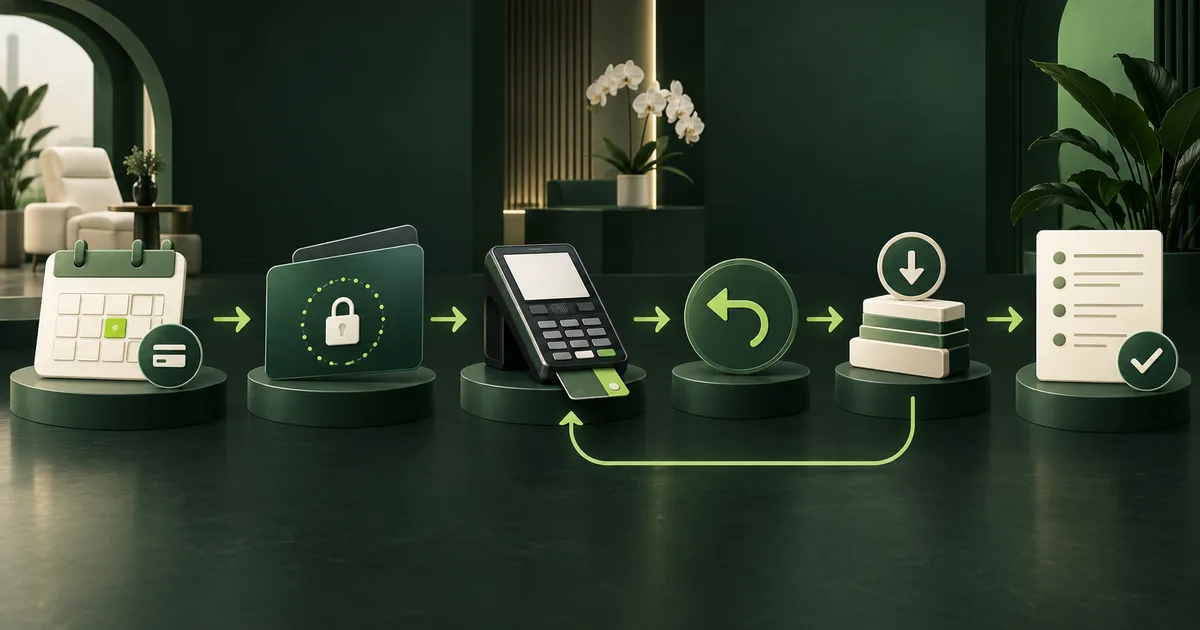
- Test the full money trail from deposit to bank payout before comparing payment rates.
- Separate software fees, processing terms, hardware, disputes, and implementation in every quote.
- Require a refund, partial refund, chargeback, failed payment, and reconciliation demonstration.
- Confirm token portability, data access, PCI DSS responsibilities, and exit terms in writing.
What is medspa payment processing software?
Medspa payment processing software is software that connects the clinic's appointment, checkout, payment, refund, and reporting workflows. A useful system shows why money was collected, how it was applied, what changed, what reached the bank, and which record explains a difference. It may include a processor or connect to one under a separate agreement.
Choose it by tracing one real payment story from beginning to end. Start with a booking deposit, complete a service and retail checkout, split or change the tender if the clinic allows it, issue a partial refund, locate the payout, and reconcile the bank deposit to the clinic record. Then test failure cases. A polished terminal or low advertised rate does not prove the rest of that chain.
This is the narrow payment review. Use the software buying guide for the broad decision, the booking comparison for appointment rules, and the membership demo test for recurring benefits. The software and website infrastructure page explains the public-site handoff.
Which payment workflows should a clinic map first?
Map the normal path and the exceptions before scheduling a vendor demo. For each step, name the initiating channel, staff owner, patient-facing message, payment record, accounting handoff, permission, report, and correction path. Use sanitized data in demos. Never paste real card details, patient records, or protected information into a worksheet or unapproved test environment.
Keep each type of value distinct. A stored credential is a reusable payment reference, not permission for every future charge. A deposit can become credit or reduce an invoice. A package can cover a service without a new card charge. Gift cards, financing, cash, and refunds can appear differently in reports.
| Workflow | What to demonstrate | Evidence to retain |
|---|---|---|
| Booking deposit | Collect, decline, waive, cancel, apply, reverse, and refund under the clinic policy. | Booking record, receipt, invoice treatment, permission history, and payout line. |
| Card on file | Capture through an approved flow, display a safe identifier, update, revoke, and use with valid authorization. | Consent or authorization record, token owner, audit event, and patient-facing control. |
| Checkout | Combine services, retail, credits, discounts, tips if used, tax rules, and more than one tender. | Final invoice, payment lines, staff identity, adjustments, and general-ledger handoff. |
| Refund or dispute | Run full and partial refunds, voids, failed refunds, chargebacks, evidence, and resolution. | Original transaction link, reason, approver, processor state, fees, and settlement effect. |
| Payout | Trace a batch from gross collections through fees, refunds, reserves, adjustments, and bank deposit. | Settlement ID, expected date, actual date, bank amount, and unexplained variance owner. |
How does the 100-point Payment Workflow Proof Score work?
Rate each finalist from 1 to 5 in the six stages below. Convert the rating to weighted points with this formula: rating divided by 5, multiplied by the stage weight. A rating of 4 in a 20-point stage earns 16 points. Score only behavior demonstrated on the proposed plan and supported by the written quote or agreement.
Download the original 48-control medspa payment software demo worksheet. Replace the sample owners and pass conditions with the clinic's policies. A critical failure overrides the total, especially when the workflow cannot protect payment data, preserve authorization, restrict adjustments, explain money movement, or provide an agreed exit.
Read from merchant terms to exit. The weights total 100. Score the exact product, payment relationship, hardware, locations, roles, and reports in the proposed agreement.
- Stage 1Merchant and contract fit15
- Demo test
- Map the merchant account, processor, software, locations, legal entities, devices, rates, fees, reserves, funding, disputes, and renewal terms.
- Full-score proof
- The written scope names each responsible party, pricing unit, dependency, support path, and termination condition.
- Stop signal
- The clinic cannot identify the processor, full fee schedule, data responsibilities, or binding payment terms.
- Stage 2Deposit and card capture15
- Demo test
- Collect a booking deposit and card through every approved channel, then decline, waive, change, apply, and refund it.
- Full-score proof
- Patient notice, authorization, token, appointment, receipt, invoice, and staff history stay connected.
- Stop signal
- Staff must copy card data, or the clinic cannot prove how a deposit or stored credential was authorized.
- Stage 3Checkout and tender logic20
- Demo test
- Run a mixed cart with services, retail, deposit credit, package value, discount, tax, tip if used, and split tender.
- Full-score proof
- The patient receipt, staff view, invoice, inventory event, payment record, and owner report agree.
- Stop signal
- The system hides tender differences or lets value be created, erased, or reassigned without control.
- Stage 4Refunds and disputes20
- Demo test
- Void before settlement, issue full and partial refunds after settlement, fail a refund, open a dispute, and show the resolution.
- Full-score proof
- Every exception links to the original payment and preserves amount, reason, approver, processor status, fees, and audit history.
- Stop signal
- A refund or dispute cannot be explained from clinic record to processor record and bank effect.
- Stage 5Settlement and reconciliation20
- Demo test
- Trace daily activity through gross sales, fees, refunds, adjustments, chargebacks, expected payout, and the bank deposit.
- Full-score proof
- The clinic can reproduce the payout, isolate timing differences, export detail, and assign every variance.
- Stop signal
- Staff must accept an unexplained net deposit or rebuild routine reconciliation by hand.
- Stage 6Permissions, data, and exit10
- Demo test
- Restrict a refund role, inspect audit history, export transactions and settlements, and explain token portability and deletion.
- Full-score proof
- Access, retention, incident, export, token, termination, and transition duties are documented and testable.
- Stop signal
- The clinic cannot retrieve required records or learn what happens to stored credentials at exit.
Which platforms document integrated medspa payments?
Aesthetic Record, Boulevard, PatientNow, Vagaro, and Zenoti all publish current material about integrated payment workflows. That makes them reasonable products to investigate, not ranked winners. The matrix records public documentation checked September 22, 2026. It does not verify uptime, support quality, effective rates, underwriting eligibility, accounting treatment, security, or clinic-specific fit.
| Platform | Documented payment signals | Commercial signal | Critical proof request |
|---|---|---|---|
| Aesthetic Record | AR Pay, deposits, cards on file, Text2Pay, Tap to Pay, wallets, refunds, and sales or deposit reports. | Processing terms and rates require the current merchant quote. | Trace a deposit and wallet adjustment through invoice, refund, processor state, and bank payout. |
| Boulevard | Stored cards, PCI-oriented collection, checkout, refunds, merchant activity, payouts, and transaction-level reports. | Medspa software and payment terms are agreement-based. | Reconcile one payout while separating cash, account credit, vouchers, refunds, tips, and fees. |
| PatientNow | Integrated checkout, invoices, cards on file, text-to-pay, deposits or links, and payment reporting. | Software pricing is tailored; obtain payment pricing and eligibility in writing. | Show the complete record across booking, checkout, processor, patient receipt, and owner report. |
| Vagaro | Online deposits, stored cards, terminals, Tap to Pay, refunds, chargebacks, and detailed deposit reporting. | Current US processing rates are published by volume and method; devices and some services add cost. | Confirm third-party processor limits, typed transaction treatment, all fees, and token exit. |
| Zenoti | In-person, online, mobile, stored credential, deposit, text-to-pay, refund, payout, and reconciliation workflows. | Software uses a customized quote; confirm payment scope, rates, devices, and location terms. | Enable and test the exact reconciliation, permission, legal-entity, and mismatch workflow. |
What should Aesthetic Record prove?
Aesthetic Record's official AR Pay page describes integrated readers, cards on file, Text2Pay, Tap to Pay on iPhone, deposits, financing, wallets, and reporting. Its invoice guidance distinguishes voids from refunds and explains refund methods, activity history, and deposit credits.
Ask the demo team to show when a deposit stays tied to an appointment and when it becomes general wallet value. Then refund the original source, apply wallet credit at checkout, correct an error, and find each event in the activity log and deposit report. Aesthetic Record's sales reporting guide explains its own reporting definitions. Have the clinic's accountant decide how those exports map to the books.
What should Boulevard prove?
Boulevard's Order Payments report guide documents payments and refunds with method, merchant, settlement, client, and staff fields. It recommends settlement date for bank reconciliation and explains why account credit, gift card, and voucher redemptions need filtering.
Its payout and merchant activity guide documents gross activity, fees, net payout, adjustments, chargebacks, and downloadable records. Test the actual merchant configuration because availability and pricing can differ. Also prove the clinic's stored-card collection path, refund permissions, settlement timing, report filters, and treatment of non-cash value before scoring.
What should PatientNow prove?
PatientNow's integrated payments page describes checkout, invoices, cards on file, text-to-pay, deposits or links, memberships, and reporting. The page establishes research relevance but does not answer every clinic-specific question about permissions, reconciliation, processor dependence, or export.
Use one scripted payment to expose those details. Create the appointment, collect the deposit, finish checkout, send a remote payment request, refund part of the charge, and trace the resulting payout. Ask which modules, legal entities, locations, devices, reports, and payment services are included in the proposed configuration. PatientNow uses tailored software pricing, so the written quote must name both software and payment costs.
What should Vagaro prove?
Vagaro publishes more payment pricing than the other products here. On September 22, 2026, its US processing page showed different rates above and below $4,000 per month, plus method-specific and monthly charges. Treat them as a dated starting point and confirm every cost in the merchant agreement.
Vagaro's deposit report guide documents collections, fees, refunds, chargebacks, net deposits, and exports. Its card guidance says Vagaro does not integrate with third-party readers. Token portability means the ability to transfer eligible stored payment references to another provider. Require a written answer before signing.
What should Zenoti prove?
Zenoti's payments page describes in-person, online, mobile, and text-to-pay options, saved details, deposits, no-show fees, digital wallets, tips, financing connections, and reporting. Its pricing page uses customized quotes, so confirm the complete proposed payment scope.
Zenoti's payment reconciliation guide describes comparing collections with payouts and investigating mismatches. It also documents enablement and role requirements and limits the report's date ranges. Have Zenoti enable the proposed workflow in a safe demo, then test permissions, prior-period investigation, adjustments, multiple locations or legal entities, export, and ownership of unresolved differences.
How should a clinic compare payment cost?
Do not compare one percentage. Normalize at least three months of real, de-identified transaction patterns by channel and method. Separate in-person card-present volume, manually keyed payments, online deposits, cards on file, recurring charges, text links, digital wallets, refunds, disputes, and financing. Then include software, hardware, monthly, gateway, statement, batch, funding, dispute, retrieval, refund, PCI-related, minimum, and early-termination charges where they apply.
Ask each vendor to price the same scenario and state every assumption. Payment reconciliation is the process of matching clinic activity, processor settlements, and bank deposits. Effective cost is total payment-related cost divided by processed volume, but it needs context. For example, a low rate may require added software, devices, a long agreement, or more staff work. Can the team explain every variance?
| Cost layer | Put in the comparison | Evidence |
|---|---|---|
| Processing | Rate model, card type, channel, assessment treatment, markup, and transaction charge. | Current merchant quote and sample statement calculation. |
| Platform | Required tier, users, locations, payment module, portal, messages, reports, and API access. | Order form with included and excluded items. |
| Operations | Devices, replacements, onboarding, migration, training, support, reconciliation, and double-running. | Implementation scope, device list, and named owners. |
| Exceptions | Refund treatment, failed payment, dispute, retrieval, reserve, adjustment, and delayed funding. | Fee schedule and demonstrated report trail. |
| Exit | Term, renewal, termination, export, read-only access, token portability, and deletion. | Agreement language and a usable sample export. |
What should every vendor demonstrate live?
Give every finalist the same sanitized story. A patient books online and pays a deposit, then buys one service and one retail item, applies the deposit, uses a stored credential, and needs a partial refund. The next day, the owner reconciles the payout. Can every finalist complete that story on the exact quoted plan, hardware, locations, and roles?
Do not stop at a successful card tap. For example, decline the deposit, correct the wrong tender, reverse an adjustment, fail a refund, open a dispute, restrict a staff role, and export the record. The implementation checklist turns the demo into release evidence. The migration plan adds token, cutover, reconciliation, and rollback controls.
- Identify the merchant of record, processor, software vendor, bank account, and support owner for each step.
- Show the patient notice and clinic record supporting deposits, stored credentials, recurring use, refunds, and fees.
- Prove who can void, refund, discount, waive, change tender, adjust credit, export, and view full reports.
- Trace processor IDs and settlement IDs from invoice through payout without relying on a private spreadsheet.
- Export payments, refunds, disputes, fees, payouts, and audit history, then open the files outside the product.
- Explain outage behavior, duplicate prevention, terminal replacement, incident notification, retention, and deletion.
What PCI DSS and HIPAA boundaries matter?
Outsourcing can reduce scope, but it does not erase merchant responsibilities. The PCI Security Standards Council says an outsourcing merchant still manages provider status, written responsibilities, shared duties, and required validation. Confirm the exact path with the clinic's acquirer or payment brand. Read PCI SSC's outsourcing guidance.
For web payments, implementation details matter. PCI SSC says SAQ A eligibility for an iframe depends on all card-capture elements originating from validated third-party providers. Its iframe guidance explains the boundary. Ask who controls every script, form, redirect, domain, terminal, network, and administrative account.
HIPAA status is separate. HHS says a financial institution performing normal consumer-directed card, check, or funds-transfer activity is not a business associate for that activity. Other vendor functions involving protected health information can create different obligations. Map each party's data and have qualified counsel review the relationships. See HHS business associate guidance.
How should a clinic make the final decision?
Shortlist no more than three products after documenting the workflow and costs. Have the owner, front desk, finance, implementation, and privacy or security owners score their sections independently. A sales promise earns no points until the proposed configuration or written scope supports it.
Choose after reviewing the merchant agreement, software order, fee schedule, implementation plan, devices, support, exports, reconciliation, and exit. Keep the demo script as the acceptance test. If an integrated product fails the workflow, compare a separate processor or narrow the custom requirement.
TheClinify Portal is discovery-priced because users, modules, integrations, payment providers, data duties, and patient-facing features change the scope. The managed website offer remains $2,499 setup plus $499 per month. Payment processing, clinic software, hardware, and custom Portal work are separate unless a written proposal says otherwise.
FAQ
What is the best payment processing software for a medspa?
There is no universal winner. Compare no more than three products with the same deposit, checkout, refund, dispute, payout, reconciliation, permission, and export script. Score only the configured plan and written payment terms.
Is integrated payment processing better than a separate processor?
Integration can reduce re-entry and connect payments to appointments, invoices, refunds, and reports. A separate processor may offer different pricing, portability, or controls. Compare total cost, staff work, reconciliation, data flow, support ownership, and exit terms.
How should a medspa compare payment processing fees?
Use several months of de-identified transaction patterns by channel and method. Price all rates, transaction charges, software, devices, monthly fees, refunds, disputes, funding, reserves, support, and termination terms. Validate the result against the merchant agreement.
Does using a payment vendor make a clinic PCI compliant?
No vendor choice automatically establishes compliance. Outsourcing may reduce scope, but PCI SSC says merchants retain provider-management and validation responsibilities. Confirm the clinic-specific requirements with its acquirer, payment brand, or qualified adviser.
Can stored card tokens move to a new payment platform?
Sometimes, but portability depends on the processor, token type, agreements, technical process, and receiving provider. Require a written answer before signing, including who owns the tokens, migration eligibility, fees, timing, patient re-entry, and deletion after exit.
Need the payment workflow mapped before you build?
Bring your current processor statement, refund policy, settlement report, and software shortlist. We can scope how a custom Portal should connect your website, clinic workflow, and payment provider.
Request a Portal discovery call