Medspa Marketing Software: Compare 5 Platforms
Compare medspa marketing software for lead capture, consent, segments, email, text, booking, attribution, and export with a 100-point demo score.
Reviewed by Abdullah Wasim. Our team analyzed official marketing, messaging, lead management, booking, reporting, integration, and pricing documentation from Aesthetic Record, Boulevard, PatientNow, Vagaro, and Zenoti on September 24, 2026. We also reviewed current HHS, FTC, and FCC guidance. We report vendor capabilities as documented claims, not verified performance. We did not conduct hands-on product tests.
Our team found 98 impressions and no clicks across two built-in marketing feature queries in TheClinify Search Console during the 90 days ending September 22, 2026. Almost all impressions landed on the broader software buying guide. We used that first-party observation to select this narrower topic, not as a market benchmark. Bing Webmaster data was unavailable because the connected account was not authorized for the site.
We built the six-stage Marketing Workflow Proof Score and 48-control worksheet as original editorial tools. They are not industry standards, legal tests, security assessments, or forecasts. Product behavior, prices, usage fees, promotions, availability, integrations, and contract terms can change, so request a current demonstration and written quote.
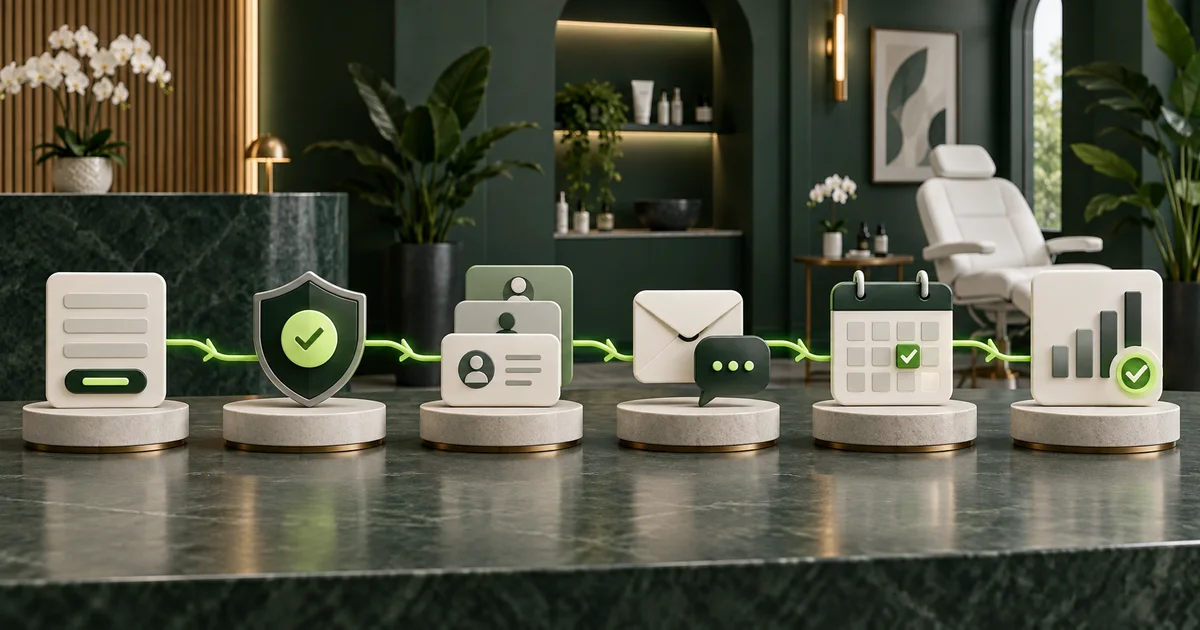
AI assisted with research, drafting, and code checks. We reviewed the sources, logic, layout, and language. OpenAI ImageGen created the original featured artwork without a vendor interface, logo, patient, clinical procedure, or performance claim. This guide is not clinical, legal, privacy, security, telecommunications, or advertising advice.
- Test one lead-to-booking path, including replies, opt-outs, failures, and attribution, before comparing feature lists.
- Keep operational reminders, patient communications, and promotional campaigns separate in the requirements.
- Score only the configured plan and retain the consent, audience, delivery, booking, revenue, and export evidence.
- Treat privacy, advertising, calling, texting, email, clinical, and state-law decisions as clinic-owned work.
What is medspa marketing software?
Medspa marketing software connects lead capture, permission, audience selection, email or text campaigns, replies, booking, and performance reporting. A useful system can show who entered a campaign, why the person was eligible, what was sent, what happened next, and how a booked appointment was attributed. For example, it may be built into clinic management software or connected through an approved integration.
Choose the product that proves the approved workflow on the proposed plan. Create a sanitized lead, record the permitted channel, build the audience, send the message, capture a reply, complete the booking, process an opt-out, and trace the result. Then test missing consent, delivery failure, and another booking channel.
This guide covers the marketing workflow, not the whole clinic system. Use the medical aesthetics software buying guide for the broad platform decision, the booking software comparison for appointment logic, and the software and website infrastructure page for the public-site handoff.
Which marketing workflows should a clinic map first?
Map the journey before scheduling demos. Name the source, data, permission, system of record, audience rule, sender, reply owner, booking destination, attribution window, report, and suppression path. Audience segmentation is the process of including and excluding contacts with documented rules. Use synthetic or properly sanitized demo data.
Keep message purposes separate. An appointment reminder, a response to a patient question, a review request, and a promotional reactivation campaign can have different operational and legal considerations. A contact record does not automatically establish permission for every channel or purpose. Have qualified counsel and the clinic's privacy lead approve the rules before configuring automation.
| Workflow | What to demonstrate | Evidence to retain |
|---|---|---|
| Lead capture | Create leads from the website, phone, manual entry, import, and approved integration without silent duplicates. | Source, timestamp, submitted fields, notice, permission record, owner, and duplicate rule. |
| Audience building | Include and exclude contacts by documented behavior, status, location, service interest, and channel eligibility. | Readable segment logic, preview count, exclusions, saved version, and approver. |
| Campaign delivery | Draft, approve, test, send, pause, correct, and suppress email and text messages. | Content version, sender, schedule, consent basis, delivery state, opt-out, and audit history. |
| Reply and booking | Route questions, recognize replies, preserve context, and connect the person to the correct booking path. | Conversation owner, response time, handoff state, appointment ID, and failure queue. |
| Attribution and exit | Explain campaign results, export the underlying records, honor suppression, and remove an integration. | Metric definitions, lookback rule, raw export, unmatched records, retention, and exit terms. |
How does the 100-point Marketing Workflow Proof Score work?
Rate each finalist from 1 to 5 in the six stages below. Convert the rating to weighted points with this formula: rating divided by 5, multiplied by the stage weight. A rating of 4 in a 20-point stage earns 16 points. Score only behavior demonstrated on the proposed plan and confirmed by the written quote, agreement, or current product documentation.
Download the original 48-control medspa marketing software demo worksheet. Replace the sample owners and pass conditions with clinic policies. A critical failure overrides the total, especially when the clinic cannot explain permission, prevent an ineligible send, preserve an opt-out, protect patient information, route a reply, or retrieve its records.
Read from lead capture to reporting and exit. The weights total 100. Score the exact plan, locations, channels, message volume, integrations, roles, and data practices in the proposal.
- Stage 1Capture and consent20
- Demo test
- Create a lead through every approved source, preserve notice and channel permission, merge a duplicate, correct data, and suppress an ineligible contact.
- Full-score proof
- Source, timestamp, fields, permission, purpose, owner, changes, and suppression remain inspectable.
- Stop signal
- The clinic cannot tell why a person is eligible for a message or prevent an ineligible send.
- Stage 2Audience and content15
- Demo test
- Build, preview, save, approve, and reproduce an audience and message without exposing more data than the workflow needs.
- Full-score proof
- Segment logic, exclusions, content version, links, sender, reviewer, and test record are retained.
- Stop signal
- Audience membership is opaque, exclusions are unreliable, or one user can publish without required review.
- Stage 3Delivery and response20
- Demo test
- Send email and text where proposed, then test delivery, failure, reply, quiet hours, pause, correction, unsubscribe, and help requests.
- Full-score proof
- Every message has a state, the reply reaches an owner, and opt-out or failure updates the right channel promptly.
- Stop signal
- Replies disappear, suppression is delayed, or staff cannot distinguish sent, delivered, failed, and answered.
- Stage 4Booking handoff15
- Demo test
- Move an eligible recipient from message to the correct service, location, provider, consultation, deposit, confirmation, and staff queue.
- Full-score proof
- Campaign, link, landing context, appointment, source, patient message, and staff record stay connected.
- Stop signal
- The campaign drives to a generic or broken booking path, or the clinic loses the source during handoff.
- Stage 5Attribution and learning20
- Demo test
- Reproduce audience, sends, delivery, clicks, replies, bookings, cancellations, completed visits, revenue rules, and unmatched cases.
- Full-score proof
- Metric definitions, attribution window, source IDs, exclusions, raw records, and corrections explain the dashboard.
- Stop signal
- The clinic must accept a revenue number that cannot be traced to appointments and transactions.
- Stage 6Governance and exit10
- Demo test
- Restrict roles, inspect audit history, export contacts and campaign records, disconnect an integration, and preserve suppression at exit.
- Full-score proof
- Access, retention, incidents, vendors, exports, deletion, suppression, ownership, and termination are documented.
- Stop signal
- The clinic cannot retrieve its records or guarantee that opt-outs survive a migration.
Which platforms document integrated marketing tools?
Aesthetic Record, Boulevard, PatientNow, Vagaro, and Zenoti publish material about integrated marketing workflows. That makes them reasonable products to investigate, not ranked winners. The matrix records documentation checked September 24, 2026. It does not verify delivery, consent configuration, support quality, attribution accuracy, security, legal suitability, or results for a particular clinic.
| Platform | Documented marketing signals | Commercial signal | Critical proof request |
|---|---|---|---|
| Aesthetic Record | Mass email and SMS, Smart Lists, social engagement, LeadAR, two-way texting, review links, and external CRM or email integrations. | Marketing tools vary by plan or add-on; confirm onboarding, user, message, and integration charges. | Trace a lead from source and permission through Smart List, message, reply, booking, result, export, and suppression. |
| Boulevard | Automated campaigns, one-time blasts, email and text, audience filters, replies, booking links, dashboards, and a Klaviyo integration. | Email, text, and completed-appointment campaign charges vary by feature and usage. | Reproduce the audience and show how a campaign receives credit when a client books through another path. |
| PatientNow | Lead capture CRM, pipeline, SMS and email automation, content assistance, reviews, reactivation, galleries, and reporting. | Pricing is tailored and capabilities differ by package, edition, or add-on. | Show which module owns consent, lead status, campaign, conversation, booking, attribution, and export. |
| Vagaro | Email and text templates, targeting, automated campaigns, booking or purchase triggers, campaign reports, and recurring sends. | Email allowances and text or marketing plan charges require a current account-specific quote. | Prove the exact eligibility filters, duplicate handling, replies, opt-outs, booking connection, and report definitions. |
| Zenoti | Email and SMS, trigger campaigns, booking and point-of-sale data, loyalty, automation, and campaign revenue reporting. | Software is custom-quoted; messaging consumption and optional base packs can add cost. | Trace one recipient through trigger, message, appointment, transaction, attribution rule, opt-out, and raw export. |
What should Aesthetic Record prove?
Aesthetic Record's Integration Hub lists HubSpot, Mailchimp, ActiveCampaign, Constant Contact, Twilio, and a Lead API. Its two-way texting page describes a central inbox connected to client records. The current pricing page places mass SMS and email campaigns, social engagement, Smart Lists, and LeadAR in the commercial conversation.
Create a website lead, merge a duplicate, build a Smart List, send a test, receive a reply, book, and export. Remove permission for one channel and prove that native and connected tools respect the change.
What should Boulevard prove?
Boulevard's automated campaigns guide documents five prebuilt campaign types, email and text delivery, triggers, dashboards, performance reporting, and SMS opt-in requirements. Its usage-rate guide documents unit and outcome-based charges. Boulevard also lists a Klaviyo integration for Enterprise accounts.
Test an automation and a one-time blast separately. Exclude an opted-out client, change an appointment, capture a reply, and book another way. Have Boulevard explain the attribution window and completed-appointment charge, then export the underlying records.
What should PatientNow prove?
PatientNow's official marketing platform page describes lead capture and CRM, automated SMS and email, AI-assisted content, review requests, reactivation, before-and-after galleries, pipeline management, and reporting. Its pricing page says pricing is tailored and that package or edition availability can differ.
Ask PatientNow to map which product captures the lead, stores permission, sends the campaign, handles replies, owns the appointment, and calculates the result. Run every handoff. Require the quote to name modules, users, channels, allowances, integrations, support, and export access.
What should Vagaro prove?
Vagaro's marketing page documents email and text templates, targeting, automated campaigns, tracking, reports, and a monthly email allowance. Its email marketing page describes automation based on booking and purchase history. The support center documents how users edit recurring email and text campaigns, including audience filters, content, and schedules.
Build a segment from sanitized booking history. Then book, cancel, change location, and opt out. Ask how allowances, text charges, plan fees, duplicates, replies, links, and reporting work for the proposed account. Confirm the current terms.
What should Zenoti prove?
Zenoti's email marketing page describes integrated email and SMS, marketing automation, loyalty, booking and point-of-sale data, and revenue reporting. Its marketing automation page describes trigger-based campaigns. Zenoti's pricing page uses customized quotes and states that messaging consumption is billed, with optional base packs.
Demonstrate one trigger with the proposed locations, permissions, and roles. Change the appointment and transaction, then inspect the audience and attribution. Test replies, failures, opt-outs, cross-location profiles, and unmatched bookings. Export raw records before accepting a revenue report.
How should a clinic compare marketing software cost?
Price the same 12-month scenario for every finalist: locations, users, contacts, email, text, automations, forms, integrations, API access, onboarding, migration, support, and double-running. For example, include charges tied to booked or completed appointments.
Separate fixed, usage-based, and outcome-based costs. Marketing attribution is the rule that assigns a result to a campaign or source. Add the staff work needed to build audiences, answer replies, reconcile attribution, and manage opt-outs. Price low, expected, and high-volume months with every assumption visible.
| Cost layer | Put in the comparison | Evidence |
|---|---|---|
| Platform | Required tier, locations, users, CRM, forms, automations, reporting, API, and integrations. | Order form with each included and excluded capability. |
| Messaging | Email allowance, overage, SMS or MMS segments, phone numbers, replies, toll-free or registration costs, and base packs. | Current usage schedule and three volume scenarios. |
| Outcome fees | Booking, completed-appointment, lead, transaction, or attributed-revenue charges where applicable. | Written definition, lookback window, exclusions, and worked example. |
| Implementation | Data cleanup, migration, consent mapping, templates, domains, authentication, training, testing, and double-running. | Implementation scope, owners, acceptance tests, and change rates. |
| Exit | Term, renewal, export, read-only access, suppression transfer, integration removal, and deletion. | Agreement language and a usable sample export. |
What consent and patient-data boundaries matter?
Software cannot decide whether a communication is permissible. HHS explains that the HIPAA Privacy Rule controls uses and disclosures of protected health information for marketing and distinguishes marketing from treatment and health care operations, with limited exceptions. Clinics subject to HIPAA should have qualified counsel and the privacy lead classify each workflow. Review the current HHS marketing guidance.
Commercial email has separate rules. The FTC's CAN-SPAM compliance guide covers accurate headers, truthful subject lines, ad identification, a valid postal address, and a working opt-out. Calls and texts can also raise Telephone Consumer Protection Act questions. A current FCC consumer guide explains that automated calls or texts generally require prior express consent unless an exemption applies. Requirements depend on the technology, purpose, recipient, and current law.
Suppression means preventing further messages on the affected channel or purpose. Preserve the source and timestamp, minimize content, restrict audience access, test suppression promptly, and retain the approved audit trail. A vendor badge does not make every campaign lawful, secure, or clinically appropriate.
Which demo script exposes the real workflow?
Give every finalist the same sanitized story. A prospective client submits a website form about a consultation and separately chooses whether to receive promotional text messages. The clinic routes the lead, sends an approved follow-up, receives a reply, books the correct appointment, records the outcome, and later excludes the person from one channel. Can every product complete that story on the quoted plan?
Test exceptions alongside the happy path. The software requirements checklist helps place marketing beside permissions, records, integrations, and exports. The implementation checklist turns the winning demo into release evidence.
- Submit the same lead twice from different sources and show the duplicate, merge, attribution, and permission behavior.
- Build a segment, preview every member, exclude one person, save the logic, and reproduce the count after a data change.
- Send a test email and text, then trigger delivery, failure, reply, help, stop, pause, correction, and resubscription paths.
- Book from the campaign link and another channel, then cancel, reschedule, complete, refund, and inspect attribution changes.
- Restrict a staff role, export the campaign records, disconnect an integration, and confirm suppression survives the exit.
- Open the exported files outside the product and trace one person from source to appointment without using the dashboard.
How should the clinic make the final decision?
Shortlist no more than three products after documenting the workflow, message purposes, privacy boundaries, and report definitions. Send the same worksheet before each demo. Let marketing, front desk, operations, privacy or security, implementation, and finance owners score their sections independently.
Choose after reviewing the configured quote, implementation, message pricing, attribution rules, integrations, support, export, and limitations. Keep the demo script as the acceptance test. A high total cannot cure a critical failure around consent, protected information, suppression, access, or exit.
TheClinify's managed custom clinic websites are $2,499 setup plus $499 per month. Clinic software and custom Portal work are discovery-priced because users, modules, integrations, messaging, data duties, and patient-facing features change the scope. Those services and third-party software costs are separate unless a written proposal says otherwise.
What did this guide verify, and what did it not test?
We checked the linked official pages on September 24, 2026 and recorded only documented features or commercial signals. We did not test products, agreements, integrations, delivery, privacy or security controls, regulatory compliance, support, or campaign revenue.
Vendor pages can change and capabilities can depend on plan, location, configuration, approval, usage, partner service, or contract. Treat this comparison as a demo plan. Verify the current product and terms, then use qualified review where the workflow requires it. Read our editorial policy and About page for publisher and correction details.
FAQ
What marketing features should medspa software include?
Start with lead source and permission records, duplicate handling, readable audience rules, email and text delivery states, two-way replies, opt-outs, booking handoffs, attribution definitions, role controls, audit history, and usable exports. Add capabilities only when the clinic has an approved workflow and owner for them.
Is built-in marketing better than HubSpot, Klaviyo, or Mailchimp?
Built-in tools can reduce synchronization and connect campaigns to appointments or transactions. A specialist platform can provide deeper segmentation or journey controls. Compare the whole workflow, including consent, data movement, replies, attribution, support ownership, cost, export, and exit, rather than assuming either architecture is always better.
Which aesthetic clinic software has the best marketing features?
There is no universal winner. Aesthetic Record, Boulevard, PatientNow, Vagaro, and Zenoti document different marketing capabilities. Shortlist no more than three and score the same lead, audience, message, reply, booking, attribution, permission, and export test on the exact plan you would buy.
Does HIPAA-compliant software make every marketing campaign permissible?
No. Product safeguards and contract status do not decide whether a specific use or disclosure is allowed. Message purpose, protected information, authorization, vendor role, configuration, access, and other federal or state rules can matter. Have qualified counsel and the clinic privacy lead approve the workflow.
How much does medspa marketing software cost?
Cost depends on the platform tier, users, locations, contacts, email and text volume, phone numbers, campaign or appointment charges, integrations, onboarding, migration, training, and support. Ask every finalist to price the same low, expected, and high-volume 12-month scenario in writing.
Need the marketing handoff mapped before you build?
Bring your lead sources, consent language, campaign examples, booking path, and reporting questions. We can scope how a custom Portal should connect the public website to the clinic workflow.
Request a Portal discovery call