Zenoti vs Aesthetic Nurse Software: Which Fits?
Zenoti is the clearer first demo for US clinic groups. Compare Aesthetic Nurse Software on readiness, pricing, records, booking, exit, and 42 controls.
Reviewed by Abdullah Wasim. Our team analyzed Google Search Console data for August 18 through November 17, 2026. The exact query "zenoti vs aesthetic nurse software" produced 10 impressions, no clicks, and an average position of 20.1; every impression landed on the broad booking guide. Authenticated Bing data showed no matching visible query. We checked the live sitemap, topic cluster, and current search results before assigning this canonical.
Our November 19 review used official Zenoti, Aesthetic Nurse Software, and HHS pages. Vendor documentation supports published capabilities, packaging, regions, and terms, not performance, security, compliance, clinical suitability, US availability, or a universal winner. We built the original US Readiness Gate and 42-control scorecard but did not open accounts, process patient data, inspect contracts or security programs, migrate records, or run hands-on tests. AI assisted research organization, drafting, and code checks; our team reviewed the sources, calculations, layout, and language. OpenAI ImageGen created the original featured image. This guide is business education, not medical, legal, privacy, security, regulatory, tax, accounting, or compliance advice. Current demonstrations and signed agreements control the decision.
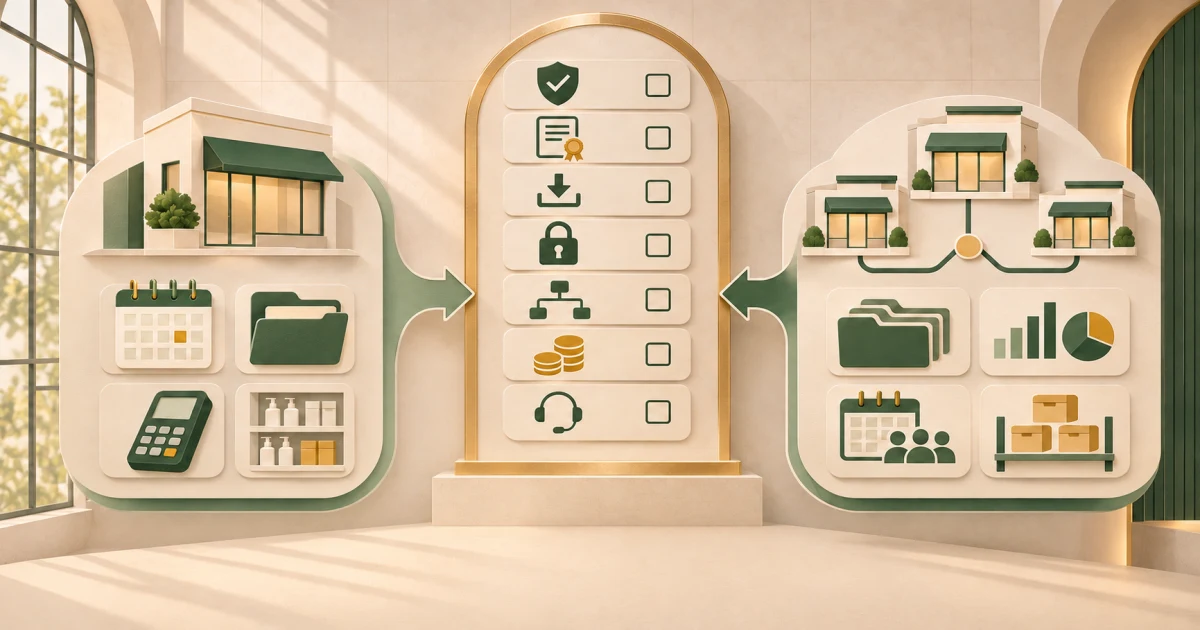
- Zenoti is the clearer first demo for a US group that needs centralized, multi-location operations.
- Aesthetic Nurse Software is the simpler first demo only after written US contract, support, data, and payment questions are resolved.
- Public ANS pages list UK prices and UK and ANZ contacts, but do not answer the US BAA question.
- Run the same 42-control test for both products. One unresolved contract, record, access, reconciliation, or export blocker outweighs a higher score.
Which is better for a US medspa, Zenoti or Aesthetic Nurse Software?
Zenoti is the clearer first demo for a US clinic that needs multi-location governance, complex operations, or a vendor product story built around US medspas. Aesthetic Nurse Software is the simpler first demo for a small clinic only after it confirms, in writing, that its contract, support, payments, data handling, safeguards, and regulatory terms fit the clinic's US requirements. This is shortlist order, not a universal verdict. A vendor can document a feature and still fail the clinic's configured workflow or contract review.
Aesthetic Nurse Software, also called ANS, publicly emphasizes a compact clinic workflow: appointments, online booking, patient records, forms, reminders, payments, reports, marketing, and stock. Zenoti publicly presents a wider operating layer that includes booking, charting, payments, memberships, workforce, inventory, marketing, reporting, and multiple locations. Use the medical aesthetics software service page to separate operating software from the public website, the software buying guide when system boundaries are unclear, and the About page to identify the publisher and editorial approach.
How do Zenoti and Aesthetic Nurse Software compare at a glance?
Zenoti is a broad operating platform with a public US medspa story. Aesthetic Nurse Software is a focused clinic system with public UK and ANZ signals. The practical difference is how much clinic complexity each product is designed to carry and whether the proposed agreement fits a US healthcare workflow. A feature list cannot decide either case.
| Decision area | Zenoti | Aesthetic Nurse Software | What the clinic must prove |
|---|---|---|---|
| Public market signal | US medspa pages and quote-led sales. | UK prices plus UK and ANZ contact teams. | Legal entity, region, support, agreement, data locations, and package. |
| Operating scope | Broad clinic and multi-location operations. | Focused booking, records, payments, marketing, reports, and stock. | Every required handoff, exception, report, and export. |
| Published pricing | Configured quote. | £25 or £50 plus VAT monthly for one practitioner; custom above 15 practitioners. | A normalized 12-month proposal with implementation, renewal, and exit. |
| US healthcare gate | HIPAA-related vendor claims still require contract review. | Public pages reviewed do not state a US BAA. | Written module scope, BAA position, data map, safeguards, incidents, return, and deletion. |
| Scale model | Central rules, shared profiles, cross-location value, and network reporting. | Plans center on practitioner count and staff access. | One shared patient, provider, exception, permission, balance, and group report. |
| Exit signal | Detailed export guide with some bulk UI limits. | Export and read-only access promised without public format detail. | Opened files, relationships, timing, fees, access period, and deletion proof. |
What do current prices and plans show?
The prices are not directly comparable. Aesthetic Nurse Software's current pricing page lists Foundation at £25 plus VAT monthly and Advanced at £50 plus VAT monthly for one bookable practitioner. Foundation includes up to 150 patients. Advanced lists unlimited patients, vouchers, booking-page options, stock controls, and staff access restrictions. A custom quote applies for 15 or more practitioners. These are UK prices, not a US proposal.
Zenoti's pricing page does not publish a standard medspa price. It groups operating, transaction, booking, marketing, reporting, and AI capabilities around a quote. Communications usage can affect the bill, and multi-location pricing is customized. Mark every requirement as included, added, usage-priced, processor-priced, partner-delivered, or unavailable.
Normalize both proposals over 12 months using the same clinics, users, modules, messages, payments, storage, integrations, migration, training, support, taxes, currency assumptions, renewal, and exit. For example, do not compare ANS's UK base subscription with a configured Zenoti proposal that includes services and usage the clinic has not priced on the ANS side. The medspa software pricing guide provides the worksheet.
What is the US Readiness Gate?
The US Readiness Gate is a pass-or-stop review completed before product scoring. ANS's contact page lists UK and ANZ teams. Its legal information identifies an England and Wales company and UK and GDPR data-protection terms. The public pages reviewed did not state a US team, a HIPAA program, or a Business Associate Agreement. That does not prove the vendor cannot serve a US clinic. It means the clinic cannot assume that it can. HHS cloud guidance says a cloud provider that creates, receives, maintains, or transmits electronic protected health information for a covered entity is a business associate, even if it holds only encrypted data. The parties need an appropriate BAA. Encryption or a cloud-hosting logo does not replace that agreement or the clinic's risk work.
- Identify the contracting entity, governing law, currency, taxes, renewal, cancellation, support, and dispute terms.
- Map patient data across forms, photos, messages, payments, integrations, backups, support access, and subprocessors.
- Confirm whether a BAA is offered, which modules it covers, and which services remain outside it.
- Review access, logging, recovery, incidents, retention, return, deletion, and audit evidence with qualified owners.
- Verify US merchant terms, then stop if a required contract, data, support, payment, or safeguard answer remains unresolved.
When should Zenoti lead the shortlist?
Lead with Zenoti when the hard part is governing a process-dense clinic or a growing location network. Its medical spa feature guide describes shared guest profiles, central services and protocols, role-based access, cross-location benefits, workforce functions, payments, memberships, marketing, inventory, and network reporting. Its booking page adds provider rules, consultation-first paths, treatment series, deposits, forms, and multi-location scheduling. These vendor claims earn a demo, not a pass. Publish one central standard and one approved local exception to two test clinics. Move the same patient and provider, redeem shared value, correct a transaction, and reproduce the network report. A single-site clinic should count setup, governance, training, and reporting work instead of assigning automatic value to a larger feature surface.
When should Aesthetic Nurse Software lead the shortlist?
Lead with ANS only after the US Readiness Gate passes and the clinic wants a focused daily path. Its features page groups booking, records, email and SMS, payments, marketing, reports, and stock. Its support page says online booking is included, staff logins and practitioner accounts are available, the team helps import patient details, and departing customers can export data with read-only access to completed records. Test a new patient from website booking through forms, deposit, synthetic visit note, photo, stock, payment, approved message, and owner report. Add a cancellation, changed phone number, restricted user, refund, record correction, failed message, and low-stock item. A simpler product is valuable only when the required path stays inside it, from the first booking through the final owner report.
How should clinics compare patient records and forms?
Compare record integrity, not template count. ANS's patient records page describes documentation, medical history, forms, photos, and stock links. Zenoti describes charting, forms, consent, photos, treatment history, injectable tracking, role controls, and audit trails. Public descriptions cannot establish clinical suitability. Build the approved record with synthetic data. Sign it, amend one fact, attach a photo, restrict a user, require review, retrieve the earlier state, and export it. Check author, timestamps, versions, signature meaning, media links, retention, and the opened file. A usable record should preserve identity, author, time, amendment, attachment, review, and access evidence as one retrievable history. If those relationships break in the export, the clinic has not proved continuity. Qualified clinical, records, privacy, security, and legal owners must set the requirements. This is not clinical advice.
How different are booking, payments, and patient communication?
Both vendors document the main appointment path, but exceptions and regional dependencies decide the fit. ANS's booking page describes web and social booking, page customization, card-on-file cancellation handling, and use across devices. Its payments page names Stripe, Klarna, Clearpay, and GoCardless with UK-oriented fees. Verify which products and terms are available to a US entity. Zenoti documents booking, consultation-first paths, deposits, series, reminders, payments, memberships, gift cards, loyalty, and marketing. Give both vendors the same service, prerequisite, resource, deposit, message, payment, refund, credit, and cancellation. Reconcile the appointment, patient record, processor event, payout, liability, stock movement, and owner report. That report should connect every total to its source appointment, payment, stock event, and staff action without a repair spreadsheet. The booking guide provides five-platform context.
Which product has the clearer data-exit story?
Zenoti publishes more detailed offboarding documentation, while ANS makes a useful but less specific export promise. Zenoti's offboarding guide lists many operating exports. It also says guest notes and forms with associated photos cannot be bulk extracted through the user interface. ANS says departing customers can export data and retain read-only access to completed records, but its public FAQ does not define record types, formats, attachments, timing, fees, or the access period. Ask both vendors for a synthetic patient, note, form, signature, photo, attachment, appointment, stock event, stored-value balance, invoice, payment, refund, user, permission, audit event, message status, and report definition. Open the files elsewhere and check relationships, timestamps, image quality, scope, fees, timing, retention, and deletion. The migration guide turns the sample into a cutover and rollback plan.
How does the 100-point proof score work?
The Two-Platform Proof Score measures the configured package after the US Readiness Gate passes. Rate each product from 0 to 5, then multiply the rating by the category weight divided by 5. Score only configured actions, opened artifacts, written answers, proposed contract language, and representative exports. Launch blocker means a failed requirement the clinic will not accept at go-live. No total cancels a blocker. Set weights and blockers before the demos so a polished presentation cannot move the goalposts.
Rate both products against the same proposed package and synthetic clinic workflow. The seven category weights total 100 points. Complete the US Readiness Gate before scoring.
Download the 42-control CSV- Category 1US contract and data readiness20
- Same demo test
- Resolve the contracting entity, region, BAA position, data map, subprocessors, support, incident, retention, return, deletion, and payment terms in writing.
- Full-score evidence
- Proposed agreement, BAA response, module scope, data-flow answers, safeguard evidence, support schedule, merchant terms, and exit language.
- Launch blocker
- A required agreement, US support, data duty, safeguard, payment path, or exit obligation is missing or ambiguous.
- Category 2Clinical record continuity20
- Same demo test
- Create, correct, sign, review, retrieve, and export the clinic-approved form, note, consent, photo, and aftercare record.
- Full-score evidence
- Configured templates, role behavior, version history, correction trail, linked media, reviewer action, and opened export.
- Launch blocker
- A required record, signature, amendment, photo, review, retained version, or export cannot be completed or recovered.
- Category 3Booking and visit handoffs15
- Same demo test
- Book, change, arrive, document, check out, refund, rebook, and recover one visit with the correct prerequisites and resources.
- Full-score evidence
- Website path, appointment rules, form state, deposit, messages, patient record, payment, stock, rebooking, and exception history.
- Launch blocker
- A required practitioner, resource, prerequisite, payment, form, message, or recovery step can be bypassed or lost.
- Category 4Payments and commercial ledger10
- Same demo test
- Collect a deposit, take payment, use stored value, refund one line, settle the payout, and reproduce all balances and fees.
- Full-score evidence
- Transaction records, processor events, payout, liability, fee schedule, refund trail, merchant terms, and owner report.
- Launch blocker
- A patient, processor, bank, stored-value, package, or accounting total cannot be explained and reconciled.
- Category 5Staff and location governance15
- Same demo test
- Move one patient, practitioner, standard, local exception, permission, benefit, stock item, and report across two test clinics.
- Full-score evidence
- Identity, inheritance, effective dates, approvals, local scope, role access, value trail, corrections, and source-level reporting.
- Launch blocker
- The workflow creates duplicates, exposes inappropriate data, erases an approved exception, or cannot explain shared value.
- Category 6Messaging, marketing, and consent10
- Same demo test
- Move one consented inquiry through booking, reminders, visit, follow-up, opt-out, suppression, and attributed return.
- Full-score evidence
- Permission source, message status, failure route, suppression, audience membership, campaign source, appointment, and report rows.
- Launch blocker
- A withdrawn preference is ignored, a failed message is silent, sensitive data crosses the approved boundary, or attribution cannot be reproduced.
- Category 7Migration, support, and data exit10
- Same demo test
- Import representative records, resolve one failure, use support, export all required records and media, and open the files elsewhere.
- Full-score evidence
- Migration map, validation totals, issue owner, support response, export definitions, schemas, attachments, timing, fees, access, and deletion.
- Launch blocker
- A critical migration total cannot be reproduced, support ownership is unclear, or usable records cannot be retrieved on time.
What should both vendors prove in one hour?
Use the same synthetic patient journey and force one change at each handoff. Spend 10 minutes on the plan, entity, contract, support, and data map. Spend 20 on website booking, forms, documentation, a photo, checkout, and a refund. Spend 15 on access, a second location, stock, stored value, messages, and reporting. Use the final 15 for migration, support escalation, and an export opened elsewhere.
Can the vendor show the action in the proposed plan? Can it hand the clinic the artifact afterward? For instance, a refund should leave a visible transaction, permission, payout, and reporting trail. Reject roadmaps, generic security statements, and prepared dashboards as proof. Record the plan, action, artifact, owner, date, blocker, and score. If time expires, mark the control unresolved.
- Use identical synthetic patients, services, practitioners, locations, roles, products, payments, exceptions, and files.
- Require a configured action or inspectable artifact for every scored control.
- Keep roadmap promises, third-party work, unpriced dependencies, and manual repair unscored.
- Pause when a contract, record, access, reconciliation, migration, support, or export blocker remains.
How should the final decision be documented?
Write a one-page decision memo before signing. Name the plan, legal entity, regions, locations, modules, integrations, BAA status, score, blockers, workarounds, 12-month cost, owners, acceptance and renewal dates, support route, and exit terms. Link the quote, demo artifacts, contract answers, risk review, migration sample, and export.
The product should own clinic operations. The website should own service education and the approved booking route. A custom layer should own only a valuable gap. TheClinify's managed custom clinic website costs $2,499 to set up plus $499 monthly. Custom clinic software is discovery-priced because roles, integrations, data duties, validation, and support change the scope.
If one product passes, configure and govern it instead of rebuilding the same functions. If both products fail the same valuable handoff, bring the evidence to the Portal discovery call below.
FAQ
Is Aesthetic Nurse Software available in the United States?
Its public pages list UK and ANZ contact teams and UK prices. The pages reviewed on November 19, 2026 did not state a US team, US pricing, a HIPAA program, or a BAA. Ask the vendor to confirm US availability, contracting entity, support, payments, data terms, safeguards, and BAA position in writing before a US clinic evaluates features.
Is Aesthetic Nurse Software HIPAA compliant?
The public product, support, contact, pricing, and legal pages reviewed for this guide did not state a HIPAA program or BAA. That does not prove one is unavailable. A US clinic should not infer compliance from cloud hosting or encryption claims. Qualified owners should review the proposed agreement, data flows, safeguards, modules, subprocessors, and written BAA answer.
Is Zenoti or Aesthetic Nurse Software cheaper?
Aesthetic Nurse Software publishes UK monthly prices for Foundation and Advanced, while Zenoti uses a configured quote. A fair comparison must include the same users, locations, modules, messages, payments, implementation, migration, support, taxes, currency assumptions, renewal, and exit over 12 months. A lower base price is not a usable US total until regional terms are confirmed.
Which is better for a small aesthetic clinic?
Aesthetic Nurse Software is the simpler first demo if its US contract, support, data, safeguards, payment, and export answers pass. Zenoti may fit a small but process-dense clinic that needs its broader operating layer or expects credible multi-location growth. Test the configured package and complete cost rather than choosing by clinic size alone.
Can a clinic migrate between Zenoti and Aesthetic Nurse Software?
A migration may be possible, but feasibility depends on notes, forms, signatures, photos, attachments, appointments, balances, inventory, audit data, identifiers, formats, services, timing, and fees. Require representative exports and written import, validation, rollback, retention, read-only access, and deletion plans before signing.
Did both products fail the same clinic handoff?
Bring the scorecard, failed demo step, current systems, user roles, and data boundary. We will separate what belongs in the clinic website, the selected platform, or a discovery-priced custom Portal scope.
Request a Portal discovery call